


| Module | Type | Loading phase | Platforms | Content |
|---|---|---|---|---|
NsDungeons |
Runtime | Default | Win64 | The graph, the rule set, the generator, the validation, the layout, the Blueprint library, the debug component, the demo actor |
NsDungeonsEditor |
Editor | Default | Win64 | The NsDungeons Preview tab and the NsDungeons.SavePreview console command |
The plugin can contain content. Content/Demo/L_NsDungeonsDemo.umap is the demo map (/NsDungeons/Demo/L_NsDungeonsDemo).
| Folder | Content |
|---|---|
Source/NsDungeons/Public |
NsDungeons.h (module and log category), NsDungeonGraph.h, NsDungeonRuleSet.h, NsDungeonGenerator.h, NsDungeonLayout.h, NsDungeonLibrary.h, NsDungeonDebugComponent.h, NsDungeonDemoActor.h |
Source/NsDungeons/Private |
The implementations. NsDungeonGenerator.cpp holds the main steps and the validation, NsDungeonSteps.cpp the later steps, and NsDungeonLayoutBuilder.cpp the layout |
Source/NsDungeonsEditor/Private |
NsDungeonsEditorModule.cpp, SNsDungeonPreview (the controls), SNsDungeonView (paints a graph step or the layout) |
Scripts |
make_demo_map.py, which makes the demo map |
| Type | Responsibility |
|---|---|
FNsDungeonGraph |
A fixed grid of FNsDungeonNode, a list of FNsDungeonEdge between grid neighbors, and the FNsDungeonLock and FNsDungeonKey lists. Node index = Y * Size.X + X. Nodes never move. The steps only mark them |
FNsDungeonEdge |
Two nodes, a kind (None, Open, Locked, OneWay, Hidden), the lock id of a locked edge, and the node that a one-way edge opens from |
FNsDungeonLock |
A locked edge and every key id that it needs. A lock with no key never opens |
FNsDungeonKey |
The node that holds the key, and its lock |
FNsDungeonSettings |
The values of one generation. UNsDungeonRuleSet (a UPrimaryDataAsset) holds them in an asset |
FNsDungeonGenerator |
A struct of static functions: Generate, BuildLayout, Validate, and the private steps |
FNsDungeonResult |
The seed that worked, the validity, a message, the graph, the layout, and the optional steps |
FNsDungeonLayout |
The cells, the rooms (FNsDungeonLayoutRoom), and the doors (FNsDungeonLayoutDoor) |
UNsDungeonLibrary |
Blueprint calls: GenerateDungeon, GetLayoutCell, CellToLocal, LocalToCell |
UNsDungeonDebugComponent |
Draws the layout with debug lines and strings each frame while NsDungeons.ShowDebug is not 0. It keeps a copy of the result |
ANsDungeonDemoActor |
Builds a greybox floor of cube components from a rule set and a seed, binds the demo keys, and floats a step graph over the floor |
FNsDungeonGenerator::Generate runs on the calling thread. For each try, it makes a new result, seeds FRandomStream(Seed + Try), and calls TryGenerate. The first try that passes Validate gets a layout from BuildLayout and returns. After MaxSeedTries failures, it logs an error and returns the last result with bValid false and no layout.
TryGenerate runs these steps in order. With bKeepSteps, KeepStep stores a copy of the graph in Result.Steps after each one, so a valid result has 8 steps.
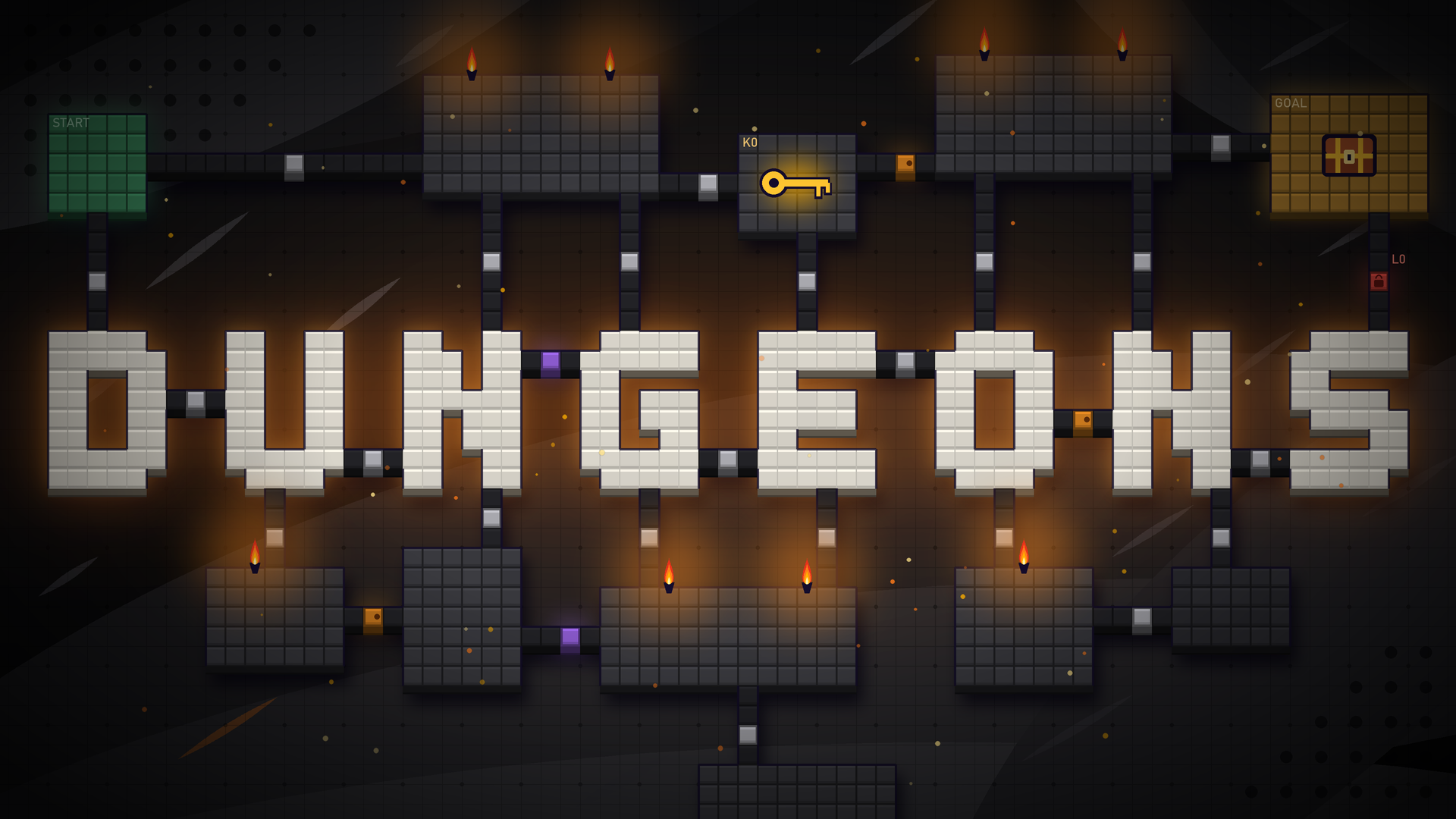
Reset). Every node is Unused. The size is at least 2 on each side.PlaceStartAndGoal). A random start, and a random goal at MinStartGoalDistance or more (grid distance).DrawMajorCycle). FindGridPath is Dijkstra with a random cost from 1 to 6 on each node, so the path wanders. Arc 0 goes from the start to the goal. Arc 1 does the same around the inner nodes of arc 0. A direct step from the start to the goal is not allowed, so each arc has a node between them. The step tries 8 times. The arcs become Path nodes and Open edges.PickCycleType, ApplyCycleType). A pick by weight. LockAndKey and TwoKeys lock the last edge of arc 0 into the goal and mark the goal with LockedArea. LockAndKey puts the key on the last node of arc 1. TwoKeys adds a second key halfway along arc 0. All types but Simple make the last edge of arc 1 a one-way edge from the goal.AddMinorCycles, NsDungeonSteps.cpp). From a room, through 1 to 3 unused nodes, back into another room. Up to 20 tries for each loop. By chance, a lock at the entry, a one-way door out, and the key in an earlier room. Then Validate runs. If it fails, the step takes the lock, the key, and the one-way door back off.AddHiddenShortcut). By chance, a Hidden edge between the two grid neighbors with the largest gap in doors from the start (more than 2).AddDeadEnds). New rooms next to rooms (not the goal) until TargetRooms, or until no room has a free neighbor.Resolve). Distance from the start, bDeadEnd, and the room tags by place, one tag for each room.A lock marks the rooms behind it with LockedArea (the goal for a major lock, the side loop for a minor lock). Steps 5 and 6 never start a side loop or a hidden door from such a room, and never use the goal. Thus they cannot make a way around a lock.
Validate walks from the start over the edges that CanPass allows. Each reached key goes into the held set, and the walk runs again until nothing changes. The graph is valid when the goal and every key are reached, and each lock matters: with its keys held back, some room is out of reach. A lock that a second way goes around fails the seed.
BuildLayout uses its own random stream, from a hash of the seed and the text NsDungeonsLayout. Each node owns a square block of Max(RoomCellsMax, RoomCellsMin) cells, with CorridorCells of rock between blocks. A room takes a random size and sits in the middle of its block, so the middle row and the middle column of a block cross its room. The corridor of an edge runs straight along that line from room A to room B. Its middle cell is the door, with the kind of the edge and the direction from A to B.
FNsDungeonGraph, FNsDungeonLayout, and FNsDungeonResult are plain value types. The caller owns them.UNsDungeonRuleSet is an asset. The engine loads it with the object that refers to it.UNsDungeonDebugComponent copies the result in SetDungeon and draws it in TickComponent. The component ticks each frame, also when the variable is 0.ANsDungeonDemoActor calls Rebuild in OnConstruction, so the floor shows in the editor viewport. BeginPlay builds again only when no layout exists. It then sets the view target of player 0, shows the mouse cursor, sets NsDungeons.ShowDebug to 1, and binds the keys. EndPlay gives back the old value of NsDungeons.ShowDebug. Each rebuild destroys the cube components with the tag NsDungeonsDemoPiece and makes new ones.FNsDungeonsEditorModule::StartupModule registers the preview tab spawner, the Tools menu entry, and the NsDungeons.SavePreview command. ShutdownModule removes them.FNsDungeonGenerator has no virtual functions, and its steps are private static functions. To change the generation, change the plugin code:
ENsDungeonCycleType and a case in ApplyCycleType. Validate checks the new type with no other change.FNsDungeonGenerator, define it in NsDungeonSteps.cpp, and call it from TryGenerate with a KeepStep after it.ENsDungeonTagPlace and a case in the filter of Resolve.Without a change to the plugin:
FNsDungeonResult::Layout in game code. The plugin has no floor builder interface.LockKind and KeyKind are FName values that the game maps to its own assets.UNsDungeonDebugComponent is BlueprintSpawnableComponent. Add it to any actor and call SetDungeon(const FNsDungeonResult& InDungeon, float InCellSize = 100.0f).| Dependency | Kind | Why |
|---|---|---|
| Core, CoreUObject, Engine | Public, NsDungeons |
Types, reflection, actors, components, data assets |
| InputCore | Private, NsDungeons |
The demo actor binds keys |
| Core, CoreUObject, Engine | Public, NsDungeonsEditor |
Base engine types |
| NsDungeons | Private, NsDungeonsEditor |
The generator that the preview calls |
| InputCore, Slate, SlateCore, UMG, PropertyEditor, ToolMenus, RenderCore, UnrealEd | Private, NsDungeonsEditor |
The preview tab, the rule set picker, the Tools menu entry, and the off screen render of NsDungeons.SavePreview |
The .uplugin lists no plugin dependencies.
Generate is synchronous. It runs up to MaxSeedTries tries, each with all 8 steps.GetEdgesOf and FindEdge scan the whole edge list. FindGridPath is an O(n²) Dijkstra over the grid nodes. The grid is at most 16 by 16.AddMinorCycles calls Validate once for each locked side loop.bKeepSteps copies the whole graph 8 times.UNsDungeonDebugComponent ticks each frame. It draws only when the variable is not 0 and ENABLE_DRAW_DEBUG is set.The plugin does not replicate. The generator uses only FRandomStream values from the seed, so the same settings and the same seed give the same dungeon.